
Anthropic has been quietly shipping one of the most capable AI model lineups available. With the Claude 4 generation now the current standard, businesses that built on Claude 3 are asking the same question: what actually changed, and is it worth upgrading?
The short answer is yes, and the gap is meaningful — especially for businesses using AI in production.
Here is the practical breakdown.
What Anthropic released: the Claude 4 lineup
The current Claude 4 generation has three tiers:
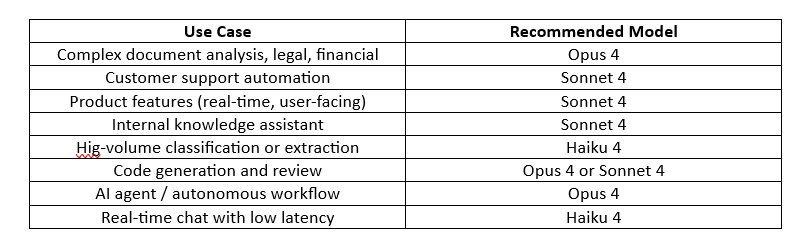
Claude Opus 4 is the most capable model Anthropic has ever released. It handles the hardest reasoning tasks — long multi-step analysis, complex code generation, nuanced writing, and extended agentic workflows. If you need Claude to think deeply and get a difficult task right, Opus 4 is what you use. It is slower and costs more per token, which makes it the right choice for high-value, low-volume tasks.
Claude Sonnet 4 is where most production applications live. It is significantly more capable than Claude 3 Sonnet, faster, and priced for scale. For businesses building customer-facing AI features, internal tools, or automated workflows, Sonnet 4 is the practical default. At Straightline, Sonnet 4 is the model we recommend to most clients.
Claude Haiku 4 is the fastest and most cost-efficient model in the lineup. It handles classification, extraction, summarisation, and real-time responses where speed matters more than deep reasoning. At scale — processing thousands of documents or handling high-volume API calls — Haiku 4 is the right economic choice.
What actually improved from Claude 3 to Claude 4
Reasoning on ambiguous problems. Claude 3 was good at clear, well-specified tasks. Claude 4 handles ambiguity significantly better — it can work with incomplete information, make reasonable assumptions, and flag uncertainty rather than hallucinate a confident wrong answer. For business use cases involving real-world data (which is never perfectly clean), this is a material improvement.
Code generation and review. Claude 4 writes better code, catches more bugs in review, and handles larger codebases in context. Engineering teams using Claude 4 for code review report finding issues that Claude 3 routinely missed. For full-stack development, the difference is noticeable from day one.
Multi-step tool use and agents. This is the biggest leap. Claude 4's ability to use tools — call APIs, run code, query databases, search the web — and chain these actions together in autonomous workflows is substantially more reliable than Claude 3. Agents that would fail partway through a task on Claude 3 now complete end-to-end reliably. This unlocks a class of business automation that simply wasn't practical before.
Instruction adherence. Claude 4 follows complex formatting and constraint instructions more consistently. If you need structured JSON output, a specific response format, or strict content guidelines, Claude 4 holds those constraints across long conversations in a way Claude 3 didn't always manage.
Longer effective context. While Claude 3 supported long contexts, Claude 4 uses that context more effectively — it doesn't degrade in quality as the context fills up the way earlier models did. Feeding a 100,000-token document to Claude 4 Opus and asking questions about the end of it produces accurate results. This matters for contract analysis, codebase review, and any task involving large inputs.
Which model is right for your use case
What this means for businesses not yet using Claude
The barrier is lower than most people think. You do not need a machine learning team or data scientists to start using Claude in a business context. The Anthropic API is straightforward, the documentation is excellent, and the first useful integration — a document summariser, a support assistant, an internal Q&A tool — can be built in days by any competent development team.
The businesses building on Claude now are accumulating an advantage that compounds. They are learning what works, building internal expertise, and shipping AI-powered products while competitors are still discussing whether AI is ready for production. It is.
What Straightline builds with Claude
We use Claude across several of our own products and client engagements:
- Reelect uses Claude to automatically categorise saved social media videos with 94% accuracy — a task that would otherwise require manual tagging by each user
- SmartSlot uses AI for voice-to-prescription transcription across five Indian languages
- Client projects in data engineering and business intelligence use Claude to interpret natural language queries, generate SQL, and summarise analytical outputs
Every one of these integrations runs on the Anthropic API. Every one started as a prototype built in a few days and evolved into a production feature based on real user feedback.
If you are curious about what Claude could do for your business — a specific process, a specific product feature, a specific workflow — talk to our team. We will tell you honestly whether it's the right tool, how long it would take, and what it would cost.