
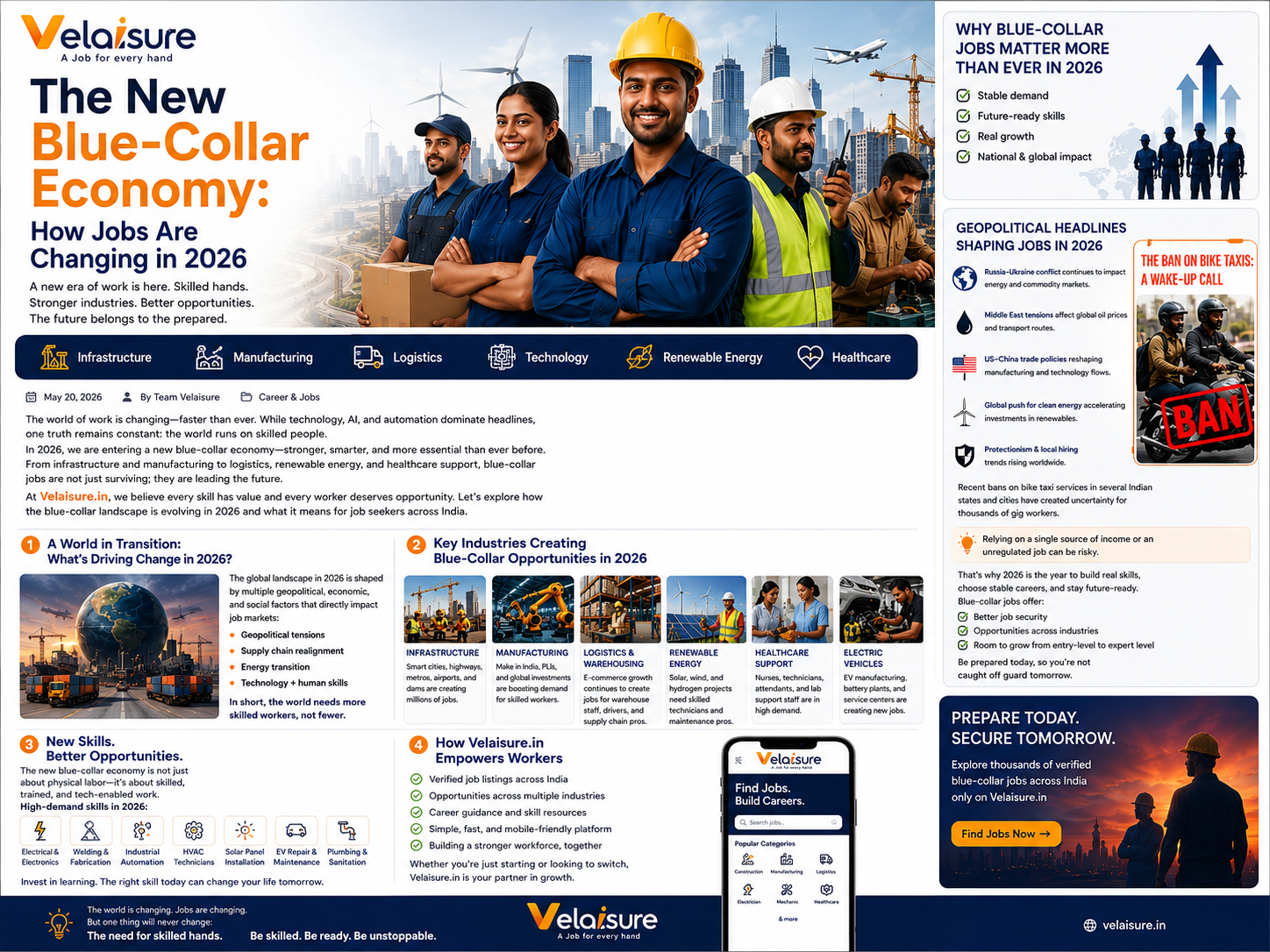
The blue-collar economy is changing.
For decades, the phrase "blue-collar job" was often associated with traditional occupations such as factory workers, construction workers, drivers, electricians, plumbers, welders and mechanics.
That definition is becoming outdated.
Today's blue-collar economy includes:
- Machine operators
- CNC technicians
- Electricians
- HVAC technicians
- Solar installation technicians
- EV technicians
- Warehouse associates
- Logistics workers
- Quality-control technicians
- Maintenance engineers
- Healthcare support workers
- Construction workers
- Welders and fabricators
- Delivery professionals
- Field service technicians
- Production operators
- Industrial automation technicians
Many of these jobs are becoming more technical, not less.
A modern manufacturing worker may interact with automated machinery, sensors, digital production systems and quality-control software.
A modern electrician may work on solar installations, EV charging systems or industrial automation.
A warehouse worker may operate barcode systems, warehouse-management software and automated equipment.
The common thread is simple:
The future belongs increasingly to workers who combine practical skills with the ability to adapt to technology.
1. Why 2026 is different
There is a bigger economic story happening underneath the daily headlines.
Countries and companies are reassessing where they manufacture products, where they source components and how dependent they should be on a single country or supply chain.
The reasons are not only economic.
They are geopolitical.
The Russia-Ukraine war continues to affect energy, commodities, transportation and supply chains. The Middle East conflict has created significant uncertainty around energy markets and shipping routes, including the strategically important Strait of Hormuz. Meanwhile, competition between the United States and China continues to influence tariffs, technology, manufacturing and global trade.
For ordinary workers, these issues may seem far away.
But they aren't.
A geopolitical event can eventually influence:
Energy prices → transportation costs → manufacturing costs → company investment → hiring decisions → jobs.
That is why understanding the changing economy is increasingly important even for people working in local jobs.
2. Geopolitical tensions are changing where jobs are created
The global economy is becoming more fragmented.
Companies are increasingly thinking about supply-chain resilience, local manufacturing and alternative production locations.
This creates an interesting opportunity for countries such as India.
India has been trying to strengthen its manufacturing ecosystem through initiatives such as Make in India and production-linked incentives.
The numbers are significant.
According to India's Ministry of Commerce & Industry, PLI schemes across 14 sectors had attracted more than ₹2.40 lakh crore in investment and generated more than 14.15 lakh jobs, including direct and indirect employment, as of March 31, 2026.
The government has also approved the Bharat Audyogik Vikas Yojana (BHAVYA), with a ₹33,660 crore allocation to develop 100 plug-and-play industrial parks between FY2026-27 and FY2031-32.
These developments don't mean every worker will automatically get a job.
But they demonstrate something important:
- Industrial capacity requires people.
- Factories need operators.
- Machines need technicians.
- Warehouses need workers.
- Construction projects need skilled tradespeople.
- Equipment needs maintenance.
- Goods need to move.
And businesses need people on the ground.
3. Manufacturing is creating a new kind of blue-collar worker
Manufacturing is no longer simply about workers standing beside machines.
Modern factories increasingly combine:
- Robotics
- Industrial automation
- Sensors
- Digital monitoring
- Quality-control systems
- Computer-controlled machinery
- Data collection
- Predictive maintenance
- Automated material handling
This doesn't eliminate the need for people.
It changes the skills companies look for.
A worker who understands both mechanical systems and basic technology can potentially become much more valuable than someone who only knows one traditional task.
India's manufacturing push is already producing employment across electronics, automobiles, pharmaceuticals, food products, telecom equipment, solar modules, textiles and other sectors. Government data shows substantial employment associated with PLI-supported sectors.
The message for workers is straightforward:
Learn the machine, not just the job.
- If you're a technician, learn diagnostics.
- If you're an electrician, understand modern electrical systems.
- If you're a mechanic, learn EV systems.
- If you're a machine operator, understand digital controls.
- If you're working in logistics, learn warehouse and inventory systems.
Skills create flexibility.
4. The bike-taxi story is an important lesson
There is another side to the changing blue-collar economy that workers should pay attention to: regulatory risk.
Bike-taxi services have become an important source of income for many people in India's cities. But the regulatory environment has been uncertain and has changed from state to state.
In March 2026, Maharashtra revoked provisional licences for bike-taxi operators after citing compliance issues.
Later, the state announced plans for a regulated bike-taxi framework, including requirements for registered aggregators and Maharashtra domicile for drivers.
Karnataka has taken a different legal path. In January 2026, the Karnataka High Court held that motorcycles could be used as transport vehicles and directed the state to consider permit applications.
Tamil Nadu has also faced continuing regulatory uncertainty around bike taxis.
The larger lesson is more important than the individual state decisions.
A job can be affected by policy overnight.
A worker who depends entirely on one platform, one vehicle-based income stream or one type of gig work can suddenly find themselves needing another source of income.
This doesn't mean gig work is bad.
It means income diversification and employable skills matter.
A bike-taxi rider may also have skills that can transfer into:
- Delivery
- Logistics
- Warehouse operations
- Field service
- Sales support
- Customer service
- Vehicle service
- Fleet operations
The smart approach is not to wait until a regulation changes.
Be ready before it changes.
5. The global energy shock makes skilled workers even more important
Energy is another example of how global events eventually reach local employment.
The ongoing conflict in the Middle East has affected energy markets and transportation routes. The IMF has highlighted the economic effects of the conflict through energy prices, supply chains and financial conditions.
When energy becomes more expensive or uncertain, businesses look for ways to become more efficient.
That creates demand for people who can:
- Install solar systems
- Maintain electrical equipment
- Improve energy efficiency
- Maintain industrial machinery
- Service renewable-energy infrastructure
- Work on EV systems
- Maintain HVAC systems
The transition toward renewable energy isn't simply a climate story.
It is also a jobs story.
- Solar installations require technicians.
- Wind projects require maintenance workers.
- EV charging networks require electricians and service professionals.
- Battery manufacturing requires trained workers.
- Industrial energy systems require technicians.
The energy transition is therefore creating an entirely new layer of blue-collar careers.
6. EVs are changing traditional mechanical jobs
Consider the automobile mechanic.
The traditional mechanic worked primarily with engines, transmissions, fuel systems and mechanical components.
The EV technician needs a different skill set.
Electric vehicles introduce technologies such as:
- Battery systems
- Electric motors
- Power electronics
- Charging systems
- Electronic diagnostics
- Battery management systems
- High-voltage electrical systems
This doesn't mean traditional mechanics will disappear.
It means mechanics who upgrade their skills can remain relevant as the industry changes.
The same principle applies across almost every blue-collar profession.
Change doesn't always destroy a career.
Sometimes it creates a better version of it.
7. Logistics and warehousing are becoming major employers
India's growing digital economy has changed consumer expectations.
People increasingly expect products to arrive quickly.
That requires an enormous physical workforce.
Behind every online order is a chain of workers:
Supplier → Factory → Warehouse → Sorting → Transportation → Delivery → Customer
Technology may automate parts of that chain, but physical operations still require people.
Warehouses need:
- Pickers
- Packers
- Inventory assistants
- Forklift operators
- Supervisors
- Dispatch workers
- Quality-control staff
- Maintenance technicians
As supply chains become more sophisticated, workers who understand technology and logistics systems can become increasingly valuable.
8. Construction remains one of the most human industries
No matter how advanced AI becomes, buildings still have to be constructed.
- Roads need to be built.
- Electrical systems need to be installed.
- Pipelines need to be maintained.
- Factories need to be constructed.
- Homes need plumbing.
- Buildings need HVAC.
- Infrastructure needs maintenance.
That means construction and skilled trades remain deeply connected to economic development.
India's industrial and infrastructure expansion is therefore important for workers in:
- Masonry
- Welding
- Electrical work
- Plumbing
- Carpentry
- Fabrication
- Painting
- HVAC
- Heavy equipment operation
- Site supervision
The opportunity isn't necessarily just finding a construction job. It is progressing from general labour toward specialised skill.
9. AI will change blue-collar jobs too
There is a lot of discussion about AI replacing office jobs.
But AI and automation will also affect blue-collar work.
The difference is that many physical jobs require something machines still struggle to provide at scale:
Adaptability in unpredictable physical environments.
A machine can perform a controlled task extremely well.
But real-world environments are messy.
Machines break.
Equipment behaves unexpectedly.
Buildings differ.
Road conditions change.
Customers have different requirements.
A technician may need to diagnose a problem that wasn't anticipated when the system was designed.
That is why the future is unlikely to be simply:
Humans vs machines.
It is more likely to be:
Skilled humans + machines + technology.
The worker who knows how to use technology may have an advantage over the worker who refuses to learn it.
10. The biggest blue-collar opportunity may be skill mobility
One of the most important changes in the new blue-collar economy is the ability to move between industries.
Imagine a worker who starts as a general technician.
With additional training, that worker could potentially move into:
Electrical → Industrial maintenance → Automation → EV systems → Renewable energy
Similarly:
Delivery → Logistics → Warehouse → Fleet operations → Supervisor
Or:
Construction helper → Skilled mason → Site technician → Supervisor
The goal shouldn't always be finding one job and staying in it forever.
The goal can be building a career ladder.
11. What skills will matter in 2026 and beyond?
Workers don't necessarily need to become software engineers.
But basic digital skills are becoming increasingly useful.
Some of the most valuable combinations include:
Electrical + Digital
Electrician + digital diagnostics + EV/solar knowledge.
Mechanical + Technology
Mechanic + electronic diagnostics + EV systems.
Manufacturing + Automation
Machine operator + CNC + automation knowledge.
Logistics + Technology
Warehouse worker + inventory software + digital scanning systems.
Construction + Specialisation
General worker + electrical/plumbing/HVAC/fabrication skills.
Healthcare + Technical Skills
Healthcare support + equipment handling + digital records.
The winning combination is increasingly:
Practical skill + technology + reliability.
12. Why workers should avoid depending on a single income source
The events of 2026 provide an important lesson.
Regulations can change.
Companies can restructure.
Technology can change jobs.
Geopolitical events can disrupt industries.
Economic conditions can change demand.
A worker cannot control all of these things.
But a worker can control their preparation.
That preparation can include:
- Learning a second skill
- Keeping certifications updated
- Building experience in multiple industries
- Maintaining a professional profile
- Applying for jobs regularly
- Building a network
- Keeping documents ready
- Understanding local employment opportunities
- Being willing to relocate when appropriate
- Learning basic digital tools
The objective isn't to live in fear of losing a job.
The objective is to make yourself employable in more than one situation.
13. This is where digital blue-collar recruitment matters
For many workers, finding the right job has historically depended on personal contacts, local contractors, newspapers, posters or physically visiting workplaces.
That model is changing.
Digital recruitment platforms can help connect workers and employers more efficiently.
This is the opportunity behind Velaisure.in.
Velaisure.in is built around a simple idea:
A job for every hand.
The future of blue-collar recruitment should make it easier for workers to discover opportunities while helping employers find people with the skills they actually need.
A good employment platform shouldn't only be about vacancies.
It should be about visibility, opportunity and career mobility.
14. The new blue-collar worker is not "just a worker"
This may be the biggest mindset change.
A skilled electrician isn't simply someone who does electrical work.
They are a professional.
A welder isn't simply someone who joins metal.
They possess a specialised industrial skill.
A technician isn't simply someone who fixes machines.
They keep businesses operating.
A warehouse worker isn't simply moving boxes.
They are part of a complex supply chain.
A construction worker isn't simply doing physical labour.
They are contributing to the infrastructure that supports an entire economy.
Skills have economic value.
And as industries become more sophisticated, that value can increase.
15. What should blue-collar workers do now?
If you're already working, don't wait for your current job to disappear before thinking about the next one.
Start preparing now.
Step 1: Identify your strongest skill
What can you do better than an untrained worker?
Step 2: Add one complementary skill
For example:
Electrician + Solar
Mechanic + EV
Welder + Fabrication
Driver + Logistics
Machine Operator + CNC
Technician + Automation
Step 3: Learn basic digital tools
You don't need to become a programmer.
But being comfortable with smartphones, digital applications, online forms, maps, payments and workplace software can make you more employable.
Step 4: Keep your job profile updated
Your experience matters.
Don't let your skills exist only in your head.
Create a professional profile that clearly shows:
- Skills
- Experience
- Location
- Certifications
- Preferred work
- Industry experience
Step 5: Keep looking at the market
- Don't wait until you need a job to discover what employers are looking for.
- Know what skills are in demand.
- Know which industries are expanding.
- Know which employers are hiring and keep a track of Velaisure.in platform for latest blue collar jobs - one and only platform for blue collar jobs.
The New Blue-Collar Economy Is About Being Ready
The biggest lesson from 2026 isn't that every blue-collar job is guaranteed.
No job is guaranteed.
Instead, the lesson is that skilled workers remain essential even as the economy changes.
Geopolitical tensions may disrupt supply chains.
Trade policies may change manufacturing strategies.
Energy prices may fluctuate.
AI may automate certain tasks.
Regulations may change gig work.
New technologies may transform entire industries.
But throughout all of these changes, businesses will still need people who can build, repair, operate, install, maintain, transport and deliver.
The worker who is prepared for change will have more options than the worker who waits for change to happen.
And that is why the new blue-collar economy is not simply about finding a job.
It is about building skills that keep you employable.
- Be skilled.
- Be ready.
- Be unstoppable.
Find Your Next Opportunity
Whether you're looking for your first job, changing careers, moving from gig work into a more stable opportunity, or simply exploring what's available in your area, staying connected to the job market can make a difference.
Explore blue-collar employment opportunities and build your next career step with Velaisure.in.
A Job for Every Hand.